Case study · Independent product
Tab. Split the bill, keep the night.
One person pays for the table and everyone else owes them part of it. The right amounts are on the receipt, but working them out line by line from a photo is slow, so people tend to divide the total evenly. I designed and built Tab to make the line-by-line version quick.
- Role
- Designer and developer
- Timeline
- Started June 2026
- Platform
- Installable web app, phone first
- Status
- Live
A real night out
On Saturday 24 October I went out in Denver with friends. We ordered at Kachina Cantina at 4:22, Lady Jane at 5:53 and Wynkoop Brewing at 8:18, then took a pool table at Wynkoop and paid for it just after 11. That made four checks, and I paid three of them.
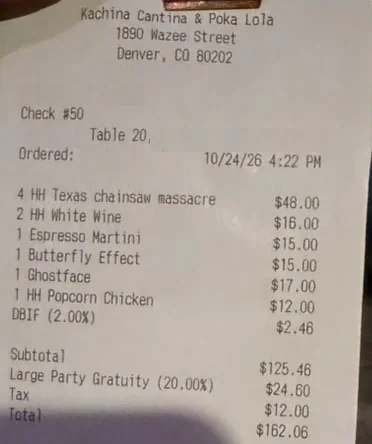
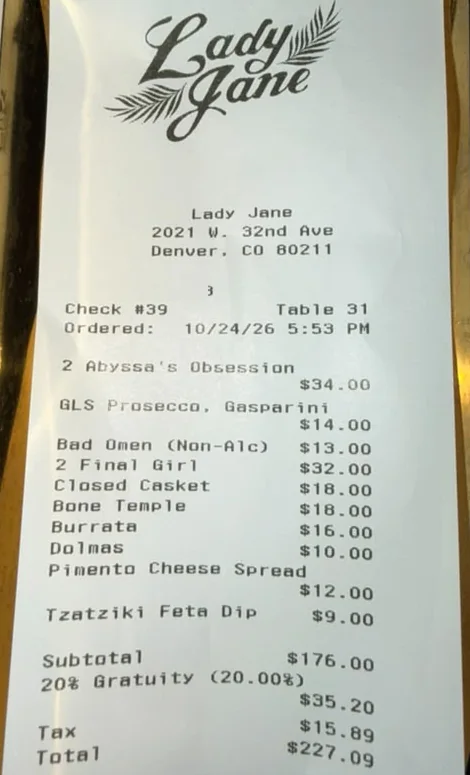
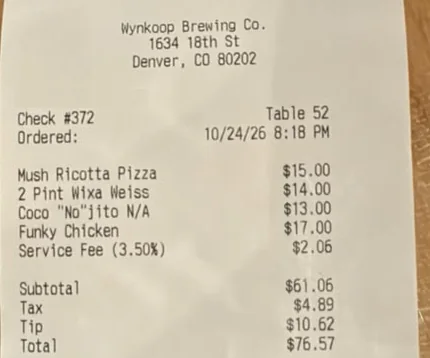
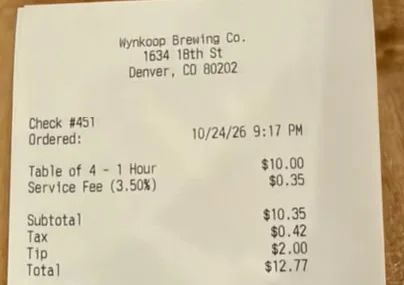
Each place charged differently. Kachina added a 2% fee and a 20% large-party gratuity. Lady Jane added a 20% gratuity. Wynkoop added a 3.5% service fee and a tip, and billed the pool table as its own check with its own fee, tax and tip.
To divide this fairly by hand, someone has to read each line, work out who had it, then share the fees, tax and tip across the right people. I built Tab on the assumption that people divide evenly because that work is too slow at the table. I haven’t tested that assumption beyond my own group.
How one check moves through Tab
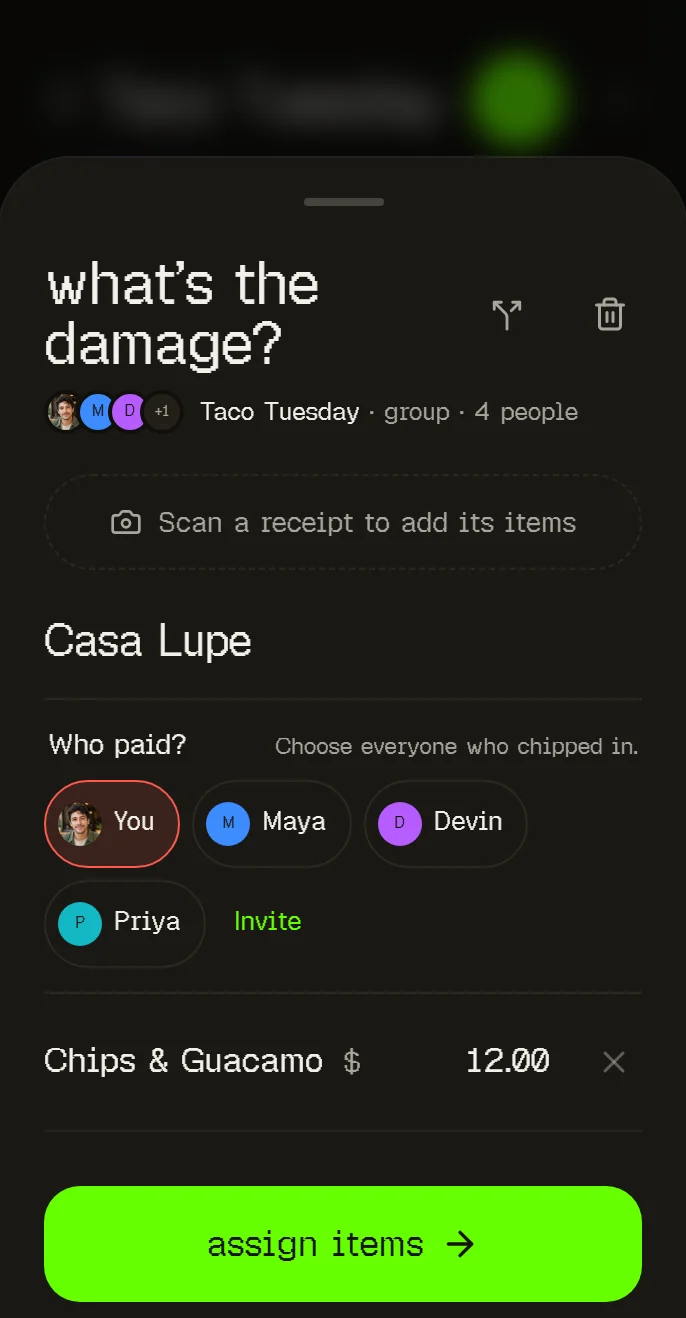
These screens come from the sample data in the prototype, Taco Tuesday at Casa Lupe. The amounts in the text are from the real night.
Capture
Scan the receipt
A photo of the receipt becomes a list of lines with prices. You pick who paid and add anyone who chipped in. The Wynkoop split has eight lines: four orders, the pool table, the service fee, tax and tip.
Starting from the lines means anyone can check a share against the paper.
Claim
Tap what you had
Pick a person and tap their lines. Their total updates with each tap, and shared tax and tip are divided in proportion to what each person claimed. At Wynkoop the tip was $10.62, and the friend with a third of a pizza paid 79 cents of it.
A counter at the bottom shows how many lines are left, so you can see when the receipt is done.
Pay
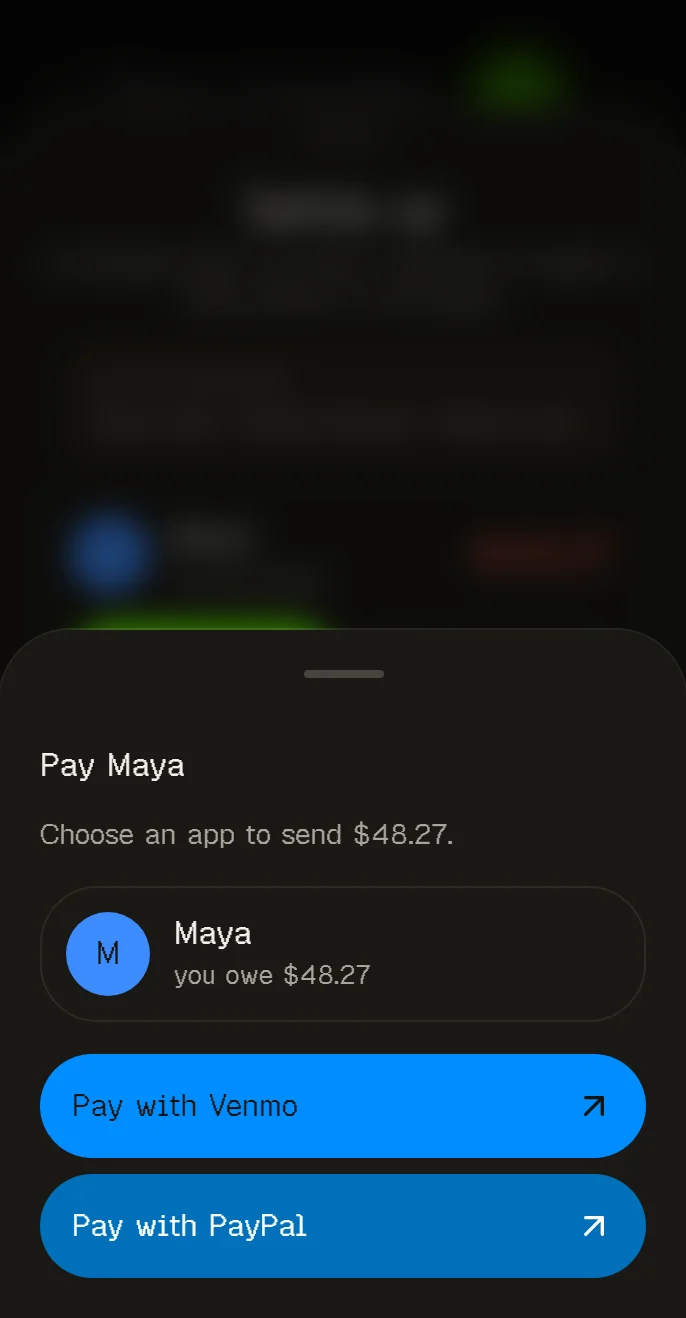
Pay whoever covered it
Everyone adds their Venmo, Cash App, PayPal or Zelle to their account once. Tapping Pay shows the apps that person accepts, and each link opens with the amount filled in. Zelle has no such link, so Tab copies the handle.
Track
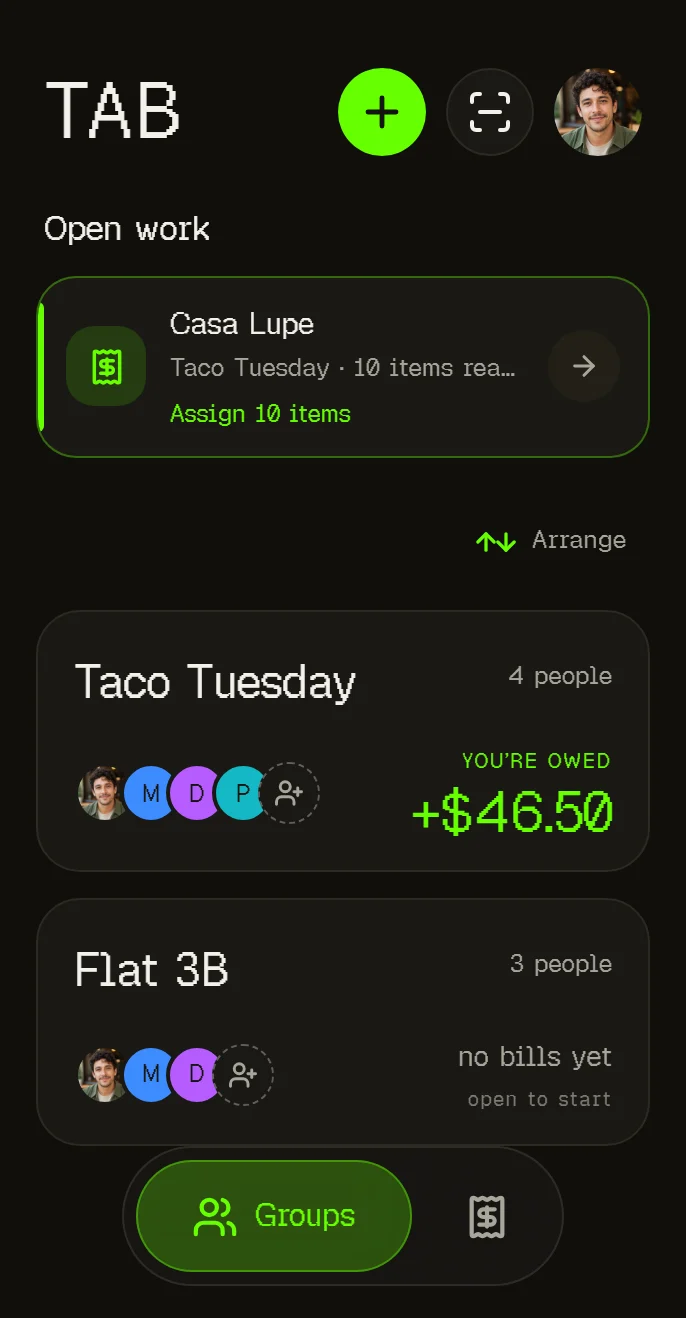
Keep a balance across bills
Bills in a group net into one balance per person. A receipt nobody has finished claiming stays at the top of the home screen as open work.
Settle
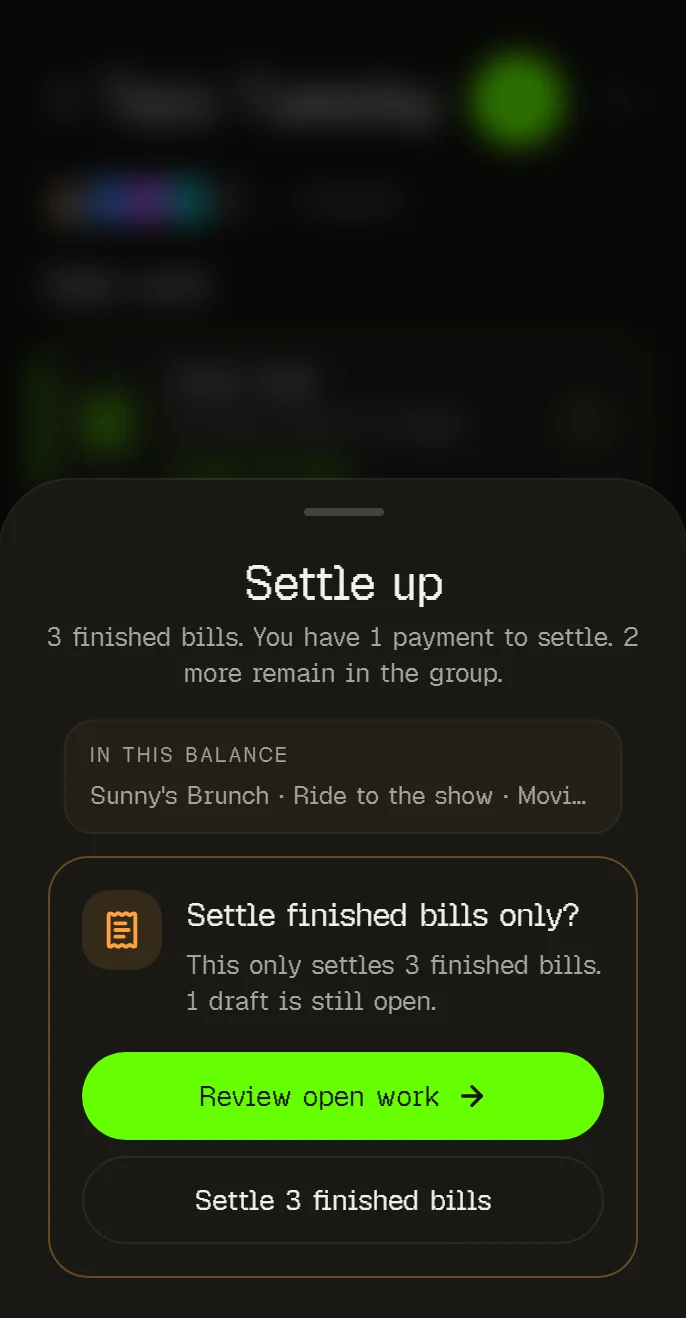
Settle finished bills
The settle sheet lists the bills in the balance and the payments left. If a draft is still open, the sheet names it and links back to it.
Decisions and tradeoffs
Divide tax and tip by what people ordered
Tab first divided shared tax and tip evenly. In July I changed it so they follow each person’s subtotal, because someone with one small item shouldn’t carry an equal part of the tip on a large dinner. Each bill keeps the rule it was created under, so the change didn’t alter old balances.
Tradeoff. Shares are harder to check in your head, so every bill shows each person’s part of every line.
Keep drafts out of balances
A half-claimed receipt would put a wrong number on everyone’s balance, so a bill counts for nothing until its split is finished.
Tradeoff. A balance can read low while a receipt is open, so the group’s settle card says how many drafts it leaves out.
Let people record their own payments
The money moves in Venmo or PayPal, where Tab can’t see it. After the payment app opens, Tab asks you to record what you sent and tells you it won’t mark anything paid on its own.
Tradeoff. It costs an extra tap, and the record is only as good as what people enter.
Ration reminders
Asking a friend for money is awkward, so a reminder talks about the bill and the app decides when one is allowed. Nothing can be sent in the first two days, and a tab gets two reminders at most, 48 hours apart. Whoever receives one can mute them without the sender knowing.
Tradeoff. After two reminders, getting paid goes back to being a conversation between friends.
What the real splits came to
I split Lady Jane and Wynkoop in Tab as private splits, with friends added by name. Kachina went on a friend’s card, so it isn’t part of this.
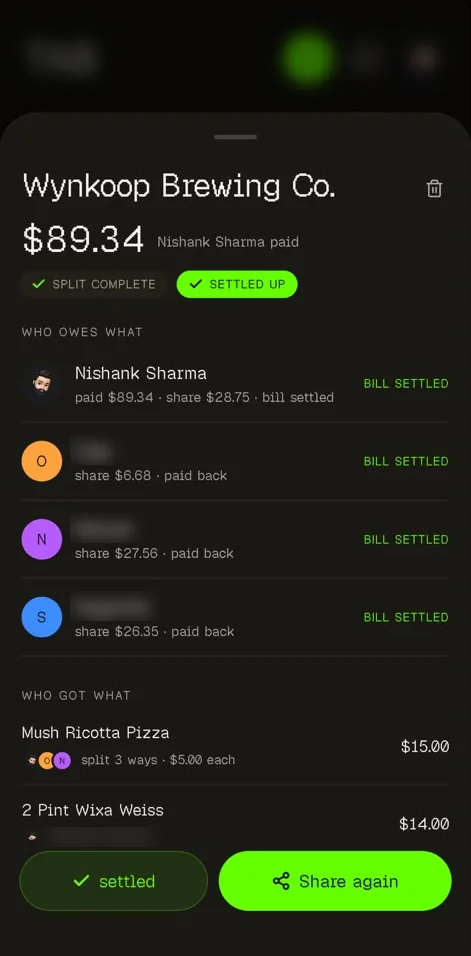
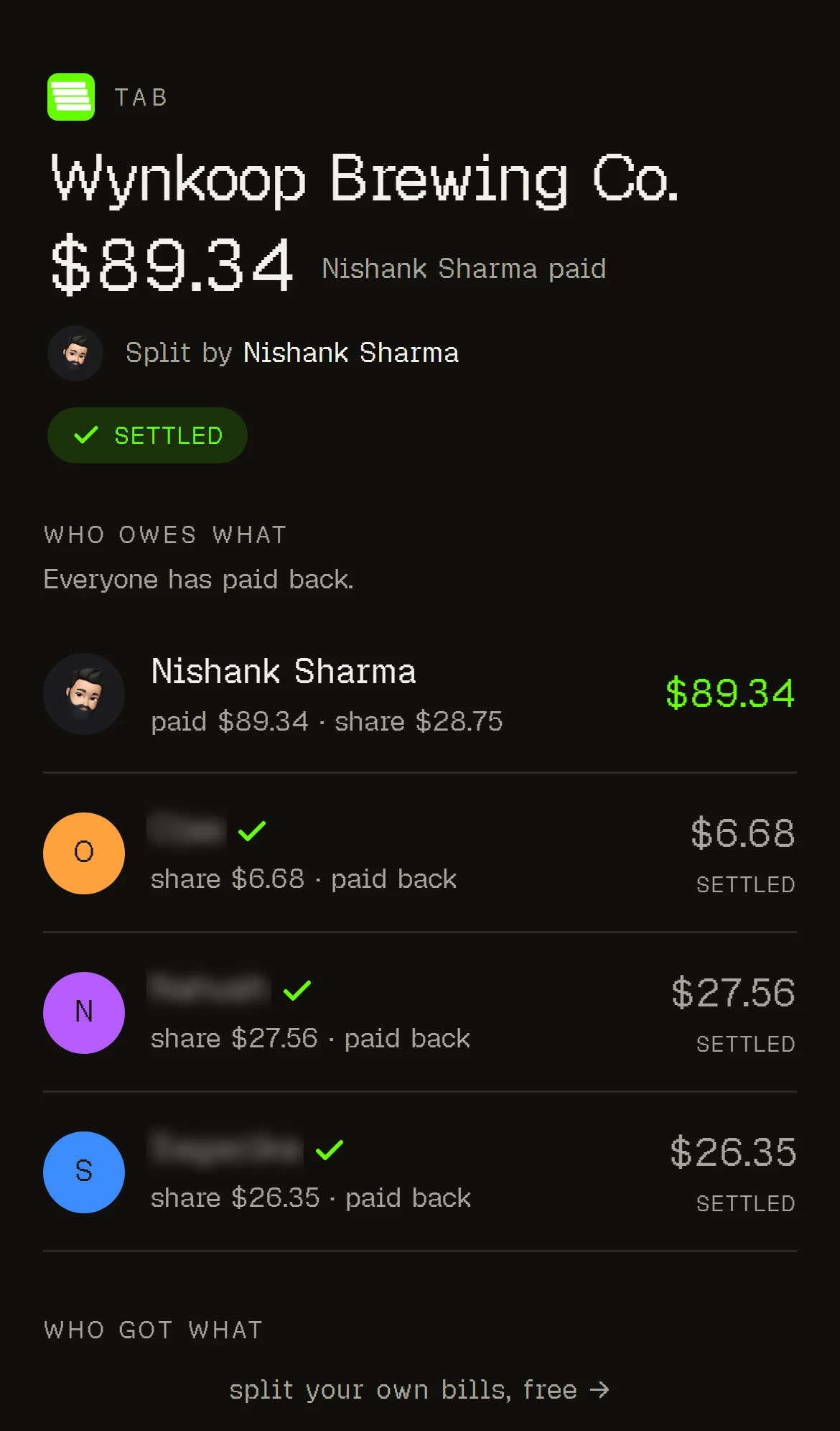
Wynkoop’s two checks came to $89.34, or $22.34 each across four people. Going by the lines:
| Person | Lines | Share |
|---|---|---|
| Me | 2 Pint Wixa Weiss, a third of the pizza, pool | $28.75 |
| Friend | Coco “No”jito, a third of the pizza, pool | $27.56 |
| Friend | Funky Chicken, pool | $26.35 |
| Friend | A third of the pizza | $6.68 |
An even split would have charged the last friend $15.66 more.
The pool check is a single $12.77 line in that split, shared by three of the four, so the whole stop is paid back as one total.
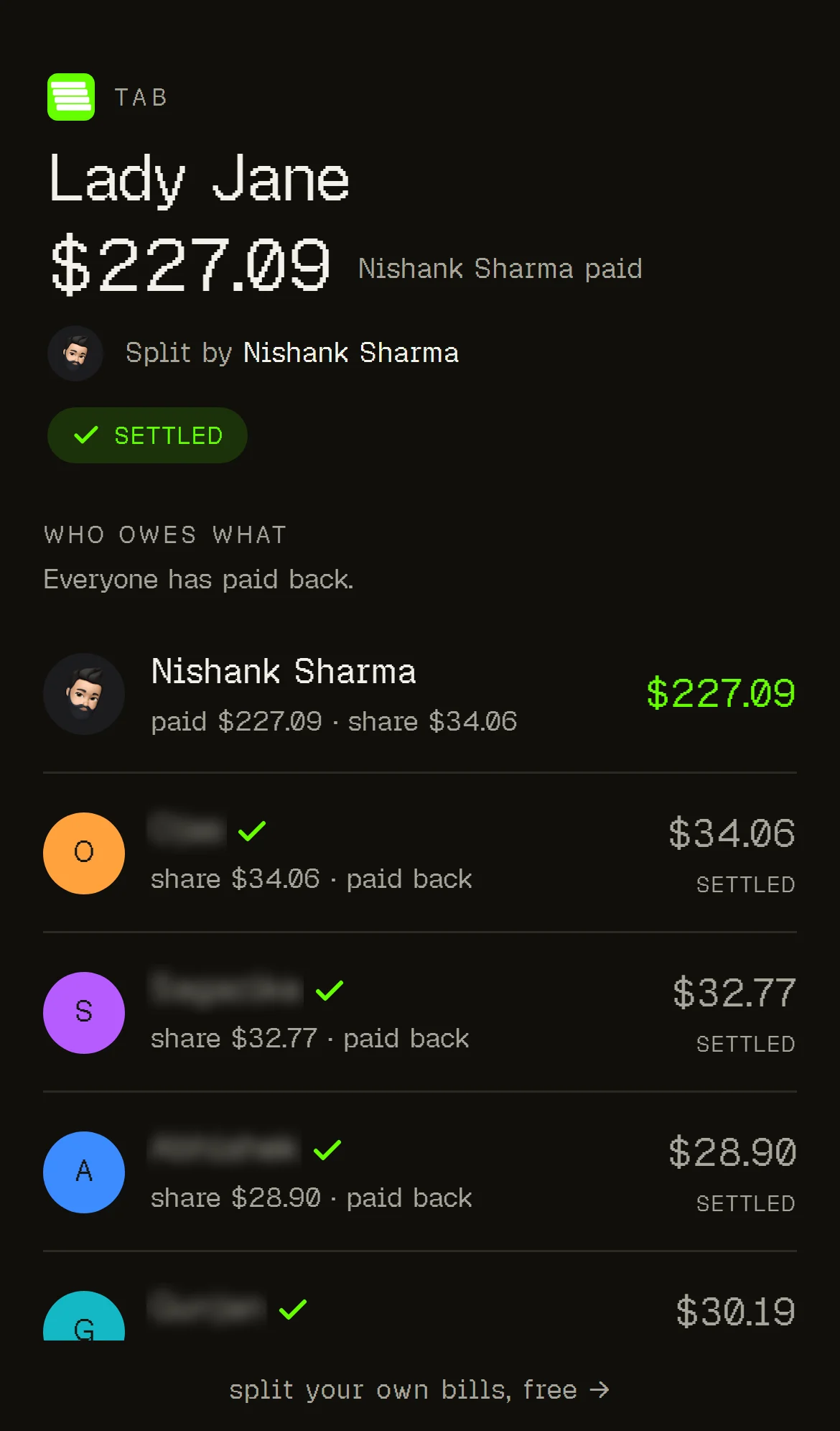
Lady Jane came to $227.09 with nine people in the split. The eight with something on the receipt owed between $20.65 and $34.06, against $28.39 for an even split. The ninth had no items and owed nothing.
Each split also has a public link. It shows names, what each person had and what they owe, with a Pay button for anyone who still owes, and a friend doesn’t need an account to open it. Both of these are settled now, so the links show paid-back marks. Friends’ names are blurred in the screenshots but visible on the links.
What I changed the next day
Neither split used a group. Nine people were in the Lady Jane split and four in the Wynkoop one, so a standing group wouldn’t have matched both.
These went out on Sunday:
- Paid-back marks
- Mark each person as paid back on a private split. The marks show on the shared link.
- Receipt on the link
- The shared link shows the scanned receipt, and Tab says when an image couldn’t be stored.
- Split by count
- Share a line by how many each person took, for lines like “2 Final Girl”.
- Reordering
- Move the items on a bill into a different order.
- Guests and moves
- Add a guest to a group bill, and move a draft between a group and a private split.
Try it yourself
This is a working copy of Tab with the Taco Tuesday group loaded. The notes beside it follow whatever you open, and the guided tour has 6 stops.
Design note: A group keeps the running score
Opening the sample table…
What I’d test next
So far I have one night of real use with my own friends and no usage numbers. Tab already records how long each bill takes to itemize, so the next step is to run it with people I don’t know and see whether they itemize when dividing evenly is still an option. I’d also watch what groups do when the settle sheet names an open draft, and whether they finish the bill first or settle without it.
What I’d carry forward
Put money rules in the flow. The settle sheet leaves drafts out, so nobody has to remember to.
Use the product on a real night early. My sample data never had a pool table on its own check.